Dog anxious when one person leaves (but fine with others)?
Fine with your partner, upset when you leave? Why some dogs struggle when one person goes, how that differs from a 'velcro dog', and how to train.
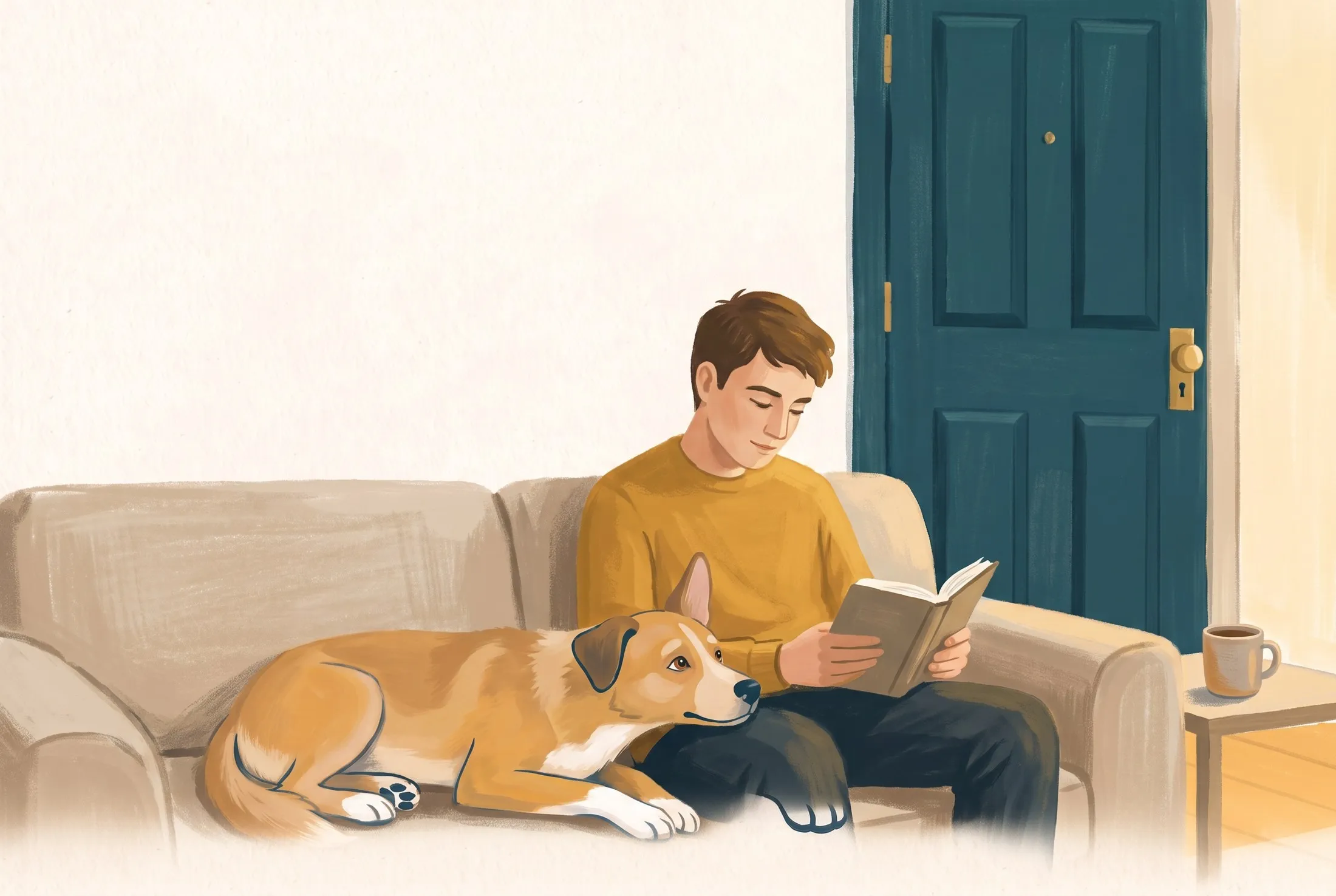
Your dog is fine when your partner leaves. When you go, the whining starts. It’s a recognized pattern — and it changes how you should train.
Why it happens
It isn’t a sign you spoiled your dog. Dogs form attachments to their people that resemble the bond between children and parents (Topál et al., 1998), and a trusted owner buffers a dog’s stress (Gácsi et al., 2013). The attachment is a strength, not the cause.
Separation anxiety or hyper-attachment?
A dog who follows one person from room to room is often called a “velcro dog”, and people sometimes call that hyper-attachment. It’s easy to assume that is what separation anxiety is. The research says otherwise.
So a shadowing dog isn’t automatically an anxious one, and a dog who seems fairly independent at home can still panic when one particular person leaves. Closeness at home doesn’t tell you much. What your dog does after the door closes does.
Signs it’s this pattern
Training in a multi-person home
- Agree on one calm routine for leaving and returning.
- Let your dog settle fully between departures if two people leave one after the other (VCA Animal Hospitals).
- Share sessions — any calm adult can run them — but make sure the key person’s departures are part of the practice.
- Film it with the threshold timer to find your dog’s number for that person leaving.
A two-adult practice week
If your dog gets worse instead of better, use the training plan’s stop rule.
Worth a professional’s view
In the meantime, company helps (though for a dog attached to one person, another dog may not be enough): if your dog is calm with others at home, arranging for someone to be there during the key person’s longer absences protects progress while you train.
Free starter guideFind your dog’s numberThe complete threshold-test chapter, the five rules and the Quick-Start Card. Free PDF.Get the free guide →Common questions
Why does my dog only cry when I leave, not my partner?
Board-certified veterinary behaviorists note that some dogs settle with anyone, while others are distressed when one particular person is gone. It isn't 'spoiling' — dogs form genuine attachments — but it does change how you train.
Should the favorite person do all the training?
Any calm adult can run sessions, and sharing them helps. For this pattern, the departures that matter most are the ones by the person the dog struggles to be apart from, so they should be part of the practice.
Is a clingy 'velcro dog' the same as separation anxiety?
Not necessarily. In a study that tested dogs' attachment to their owners, dogs with separation anxiety spent no more time close to their owners than other dogs, and the researchers concluded that separation anxiety is not simply 'hyperattachment'. What matters is how your dog copes when you're apart, which a short video will show you.
Stop guessing how long to leave your dog.
An 82-page illustrated guide, a fillable workbook, an Excel tracker that tells you what to do after every session, and a one-page card for the fridge. 111 cited sources.