Separation anxiety training: the step-by-step plan that works
The method with the best evidence is systematic desensitization: many short absences so brief that worry never starts, lengthened only as fast as your dog can handle. Here is the whole plan, stage by stage.
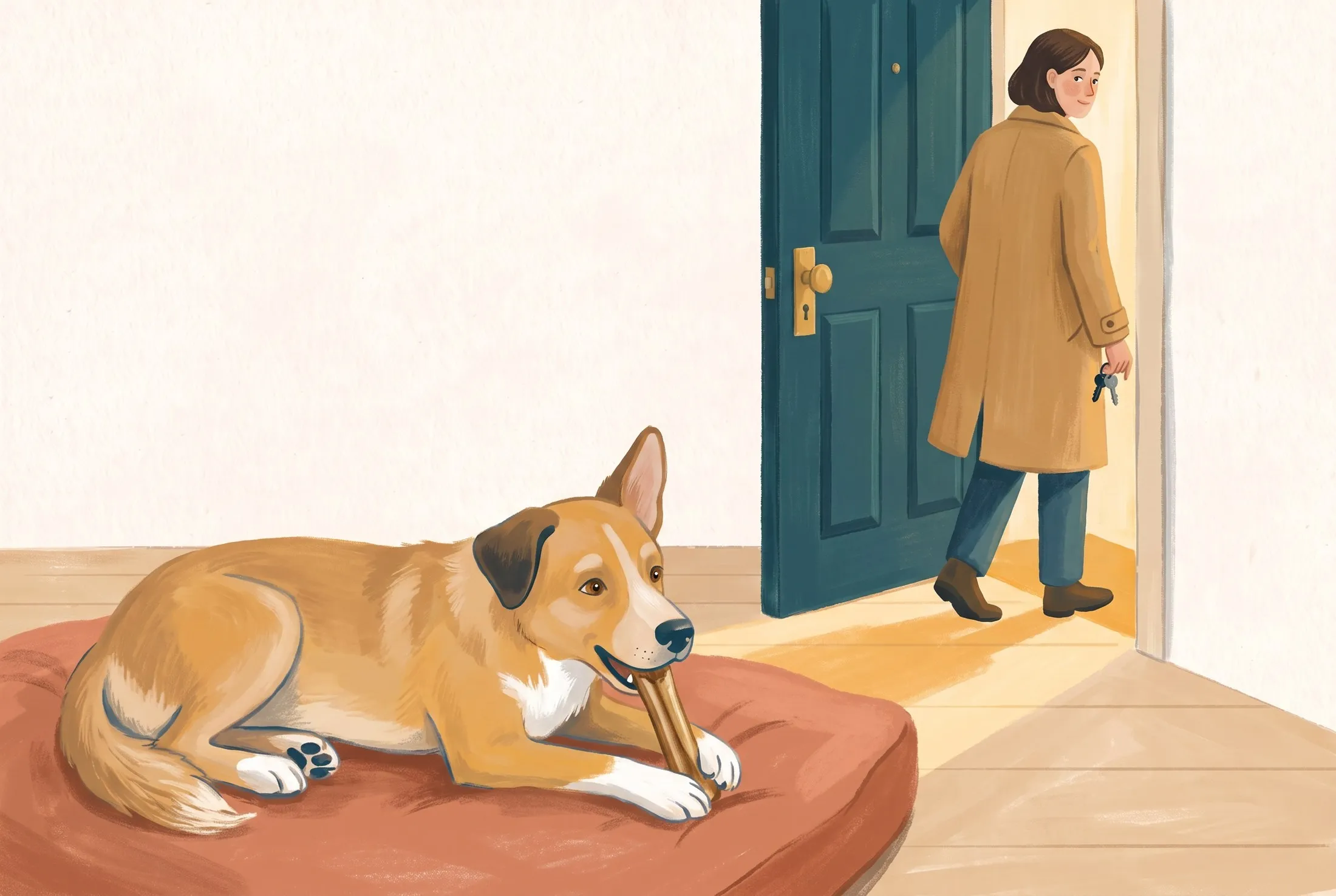
Here is the whole idea in one sentence: your dog practices being alone, over and over, for absences so short that worry never starts — and the absences grow only as fast as your dog can handle.
No gadgets, no tricks. Just a great many small, calm experiences of being alone, until being alone stops being frightening.
Why this method
Reviews of the research reach the same conclusion: the most successful treatment appears to be behavior modification built on systematic desensitization, sometimes supported by medication early on (Sargisson, 2014). Welfare organizations and veterinary behaviorists describe the same core method — many short absences that don’t trigger anxiety, slowly lengthened over weeks (ASPCA; VCA Animal Hospitals).
Before you start: vet first, then find your number
Separation problems can be caused or worsened by pain and illness, so start with a vet visit (Mills et al., 2020; AVSAB 2021). Then measure your dog’s threshold: the time from the door closing to the first sign of worry.
Free toolThreshold timerTime your dog’s first sign of worry, save each result, and see what your number means.Open the timer →Stage 0: the leaving routine (only if your dog worries before you go)
If your dog is pacing or whining before the door even closes, they’ve learned that keys, shoes or a coat mean you are about to disappear.
Stage 1: out of sight, inside the house
Start with doors inside your home. Welfare guidance begins with short absences behind an inside door — a bathroom or bedroom — before exit doors, and suggests a door you don’t normally leave by before the front door (ASPCA). Build up to around a minute of calm, then move to an outside door (the one-minute mark is our rule of thumb).
Stage 2: the absence ladder
This is the main part of the plan: short daily sessions, each made up of several practice absences, or reps.
What one session looks like
- Check your dog is relaxed before you begin.
- Do a rep: leave calmly, close the door, wait for the target time, come back calmly.
- Greet briefly and kindly, then carry on with your day.
- Wait until your dog is completely relaxed again before the next rep (ASPCA).
- Mix easy reps in with target reps — behaviorists advise increasing absences gradually and randomly (VCA Animal Hospitals).
- Watch every rep live and note it: calm, mild sign, or clear distress.
- Stop while it’s going well, on a calm rep.
After each session: go up, stay, or step back
Check these in order and stop at the first “yes”:
| Question | Then |
|---|---|
| Hurt, tried to escape, vomited or panicked? Or the longest calm time has got shorter three sessions in a row? | Stop training and call your vet or a veterinary behaviorist. |
| Any rep with clear distress? | Step back to the last target with two fully calm sessions. |
| Any mild sign — ears back, a whine, a few paces? | Stay at the same target. |
| Every rep calm in your last two sessions at this target? | Go up one small step. |
These rules are our rule of thumb, putting into practice expert advice to move up only when your dog copes and to shorten absences as soon as you see stress (ASPCA; VCA Animal Hospitals).
Free toolWhat’s my next step?Enter how each rep went and get the same go up / stay / step back answer the Tracker gives.Check my next step →How big each step should be
| Current target | Step size when you go up |
|---|---|
| Under 1 minute | Add 2–5 seconds |
| 1 to 40 minutes | Add about 10%, never more than 1 minute |
| 40 to 90 minutes | Add 5 minutes |
| Over 90 minutes | Add 15 minutes |
The first 40 minutes are the slowest part. Welfare guidance notes that most anxious responses happen within the first 40 minutes alone, recommends very small steps until then, and larger steps once your dog copes with 40 minutes (ASPCA). The exact switch points are our rule of thumb.
Bringing real life back in
Once your dog copes calmly with a few minutes, mix in the things that happen on a real departure — keys, shoes, locking the door, the car starting — one at a time, at an easy rep.
Hellos and goodbyes
If you come home to a mess
Never scold or punish. Your dog cannot connect your anger with something that happened earlier, and punishment makes the next absence more frightening. The “guilty look” is fear of you in that moment, not guilt (RSPCA; ASPCA).
The stop rule
How long will it take?
There are no standard timelines (ASPCA). In a controlled trial, 56% of owners reported significant improvement and another 25% slight improvement after 12 weeks (Blackwell et al., 2006). Think in weeks and months — and keep a record, because the slow climb is hard to feel day to day.
Common questions
How many practice sessions a day?
Our rule of thumb is one session on most days, with 3 to 6 practice absences (reps). More is fine if your dog stays relaxed. Consistency matters more than volume, and research shows imperfect practice still helps.
How big should each step be?
Under one minute, add just 2–5 seconds. From 1 to 40 minutes, add about 10% and never more than a minute at a time. From 40 to 90 minutes, add 5 minutes; beyond 90 minutes, add 15. Only go up after two fully calm sessions at the same target.
Should I ignore my dog when I leave and come home?
Not completely. Board-certified veterinary behaviorists advise: don't ignore your dog, but don't make a fuss. A quiet, kind goodbye and a quiet, kind hello.
Stop guessing how long to leave your dog.
An 82-page illustrated guide, a fillable workbook, an Excel tracker that tells you what to do after every session, and a one-page card for the fridge. 111 cited sources.