Should you crate a dog with separation anxiety?
Crates are neither good nor bad — what matters is how your dog feels in one. Some dogs relax in a crate; others have confinement distress and panic. Here's how to tell, and what to do instead.
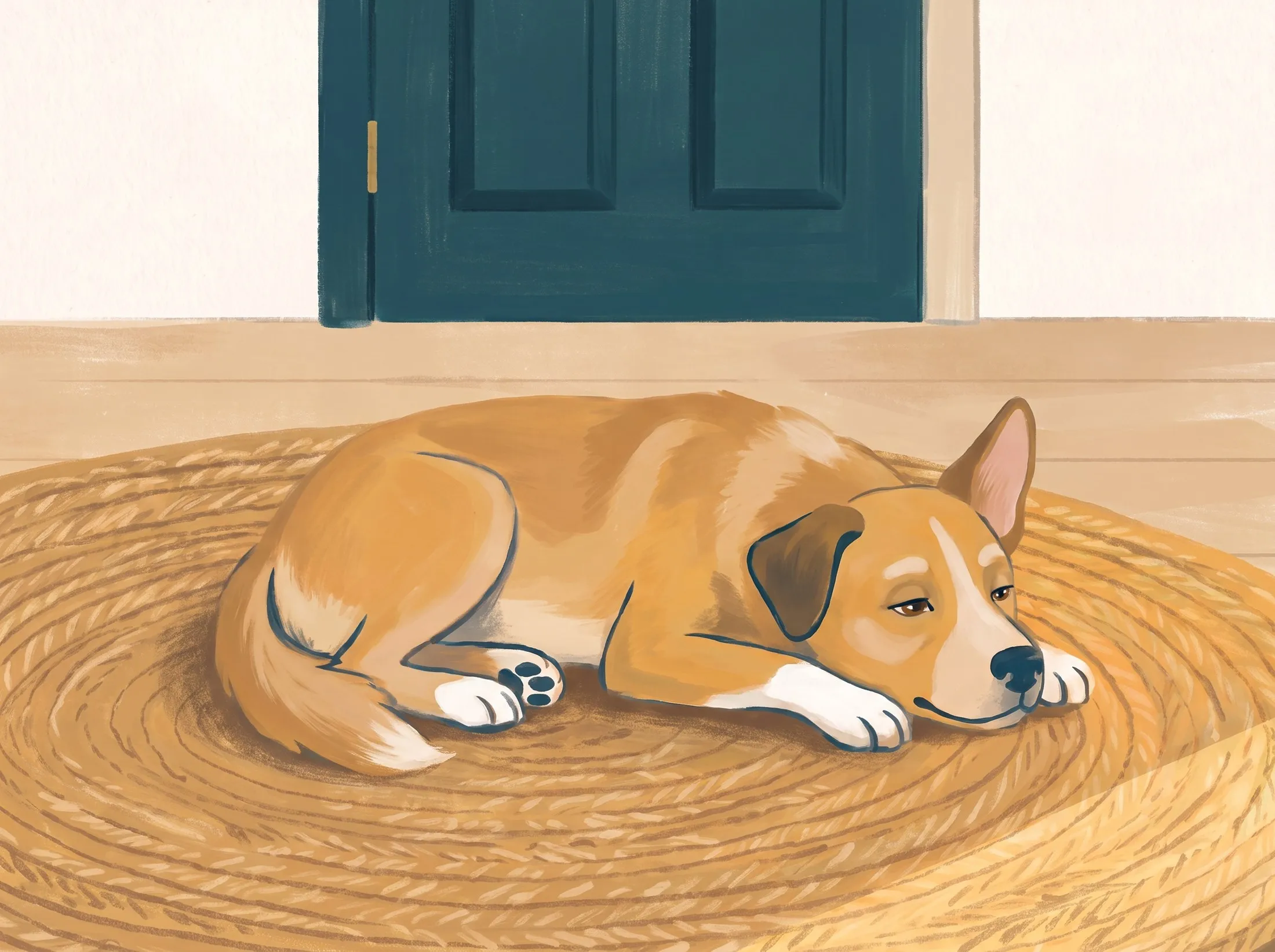
“Just crate them” is one of the most common pieces of advice for dogs who struggle alone — and one of the most misunderstood. A crate can be a calm den. It can also be a trap for a dog who panics.
What the research says
So the crate isn’t the question. Your dog’s response to it is.
How to tell whether a crate suits your dog
A simple test: film your dog in the crate with you in the next room, then film an absence. Compare with an absence where your dog has a room or a gated area instead.
| On camera you see… | What it suggests |
|---|---|
| Lying down, soft ears, sleeping | The crate is a comfortable space for your dog |
| Distress centered on the door or bars — biting, digging, frantic escape attempts | Possible confinement distress (Ballantyne, 2018) |
| The same distress in or out of the crate | Separation distress; the crate isn’t the fix |
Never “cry it out”
Leaving a distressed dog shut in to “get used to it” doesn’t teach calm — it teaches panic. And escape attempts can cause real injuries: broken teeth or nails, bleeding paws.
What to do instead
- Treat the fear, not the furniture. The approach with the best evidence is systematic desensitization: many short absences below your dog’s threshold, lengthened slowly (Butler et al., 2011).
- Use the space your dog is calmest in — a crate for some, a room or baby-gated area for others (ASPCA).
- Cover long absences with company while you train (ASPCA; VCA Animal Hospitals).
Common questions
Will putting my dog in a crate help with separation anxiety?
Not by itself. A crate doesn't teach a dog that being alone is safe. For some dogs a crate is a comfortable den; for dogs with confinement distress it makes things worse. Watch how your dog behaves in it — including while you're home.
Is a 'heavy duty' escape-proof crate a good idea?
If your dog is trying hard enough to escape that you're considering one, that's a sign of serious distress. Injury and escape attempts are reasons to see a vet or veterinary behaviorist, not to strengthen the crate.
Does putting a blanket over the crate help?
Some dogs settle better with a covered, den-like space; others don't. The test is the same as for the crate itself: watch your dog on camera. Relaxed and lying down is good; panting, drooling or frantic escape attempts are not.
Stop guessing how long to leave your dog.
An 82-page illustrated guide, a fillable workbook, an Excel tracker that tells you what to do after every session, and a one-page card for the fridge. 111 cited sources.