Does my dog have separation anxiety? Signs, look-alikes and what to rule out
Chewed doors and accidents don't always mean separation anxiety. One question, a short video and a vet visit tell you which problem you're really dealing with — here's how.
A chewed door frame can mean a panicking dog. It can also mean a bored adolescent, a dog in pain, or a dog frightened by fireworks down the street. These look alike but need different help — so it’s worth knowing which one you’re facing before you start training.
Free checklistIs it separation anxiety?Signs, the key question, and the look-alikes — in two minutes.Take the checklist →Step 1: ask one question
Does the barking, chewing or toileting happen only when your dog is alone?
If it also happens when you’re home, separation anxiety probably isn’t the whole story (ASPCA). Distress that starts within a few minutes to half an hour of leaving, and only when you’re gone, points strongly towards it (RSPCA). A short video answers this far better than memory.
Step 2: know the common signs
While you’re away (ASPCA; RSPCA; PDSA; King et al., 2000):
- barking, howling or whining that keeps going
- chewing or digging, especially at doors, windows and exits
- trying to escape from a crate or room
- urinating or defecating indoors
- pacing, often in a fixed pattern
- drooling, panting, trembling or vomiting
- ignoring food or chews they’d happily eat with you there
Around departures and returns (Flannigan & Dodman, 2001; ASPCA; RSPCA):
- getting anxious while you get ready to leave (keys, shoes, coat)
- following you from room to room
- an over-the-top greeting when you come back
In a comparison of 200 dogs with separation anxiety and 200 with other problems, extreme following, anxiety at departure cues and excessive greetings were all linked to separation anxiety (Flannigan & Dodman, 2001).
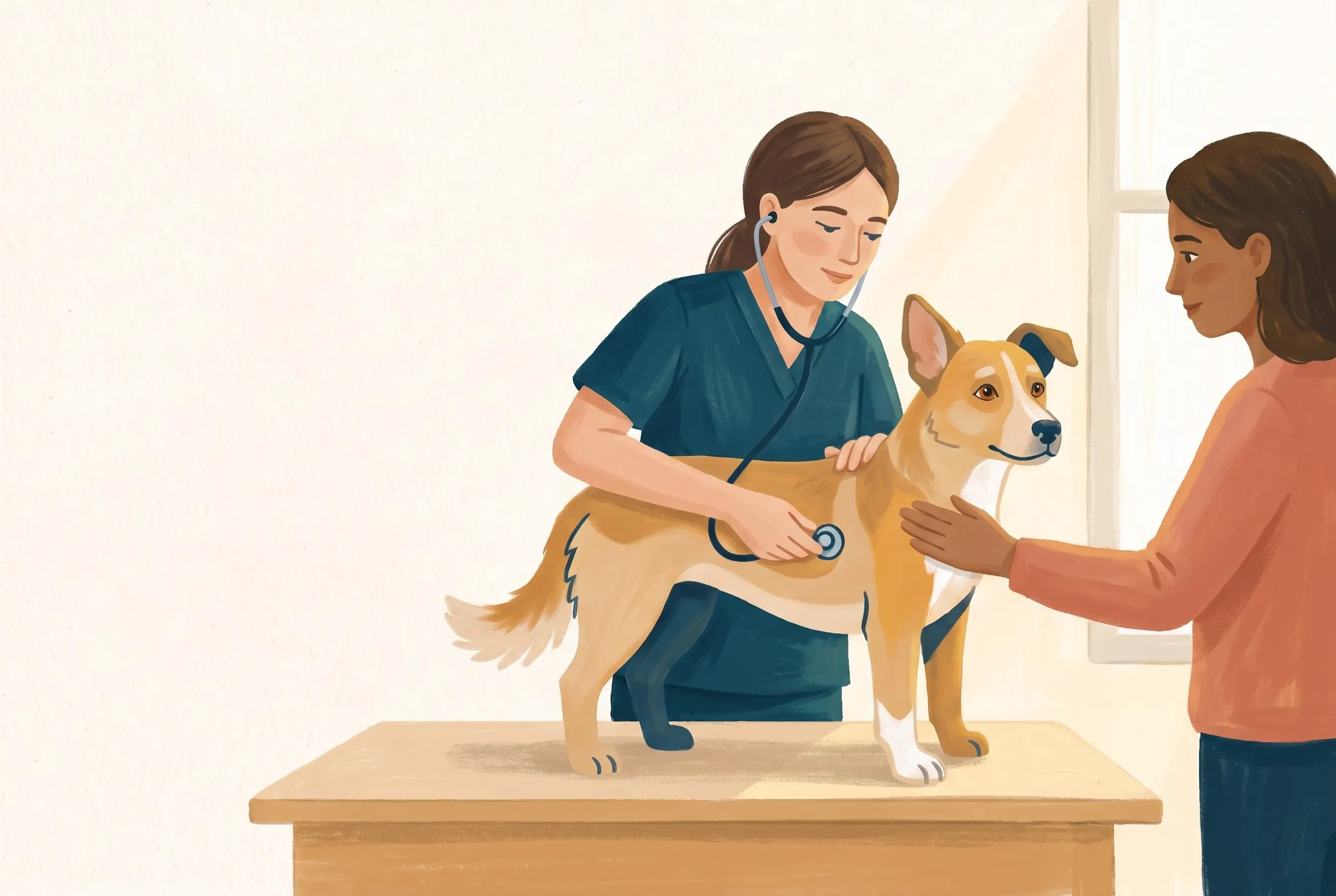
Step 3: rule out medical causes first
Other medical causes to rule out include urinary problems (infections, bladder stones, incontinence, diabetes, kidney disease), gut problems that create urgency, medications that increase thirst, and brain aging in older dogs (ASPCA; VCA Animal Hospitals).
Step 4: check the look-alikes
| What you see | Could be… | Clue |
|---|---|---|
| Chewing and destruction | Boredom or juvenile destruction | Happens when you’re home too; the dog seems relaxed, not frantic |
| Accidents indoors | Incomplete house-training | Also happens when you’re home |
| Small amounts of urine on vertical surfaces | Urine marking | Leg-lifting; not linked to your absence |
| Barking at passers-by or noises | Reactivity to outside triggers | Barks when you’re home too |
| Frantic attempts to get out of a crate or shut room | Confinement distress | Distress centers on the barrier itself (Ballantyne, 2018) |
Boredom deserves a special mention. One of the patterns researchers found within separation problems looks a lot like boredom rather than fear (de et al., 2020). Bored dogs usually don’t look anxious (ASPCA) — they may need more to do, not a desensitization plan.
Step 5: don’t forget noise fear
In a study of 141 dogs, 63% of dogs with separation anxiety also had noise phobia (Overall et al., 2001). A dog frightened by thunder, fireworks or even household noises while home alone can look exactly like a dog with separation anxiety. If your video shows your dog reacting to sounds, tell your vet — noise fears have their own treatments (Riemer, 2023).
What it isn’t: spite or spoiling
Dogs with separation problems show measurable distress — higher stress-linked hormones after separation and a more pessimistic outlook in mood tests (Pirrone et al., 2019; Karagiannis et al., 2015). And “spoiling” isn’t the cause: in the 400-dog study, spoiling activities were not associated with separation anxiety (Flannigan & Dodman, 2001).
Free starter guideFind your dog’s numberThe complete threshold-test chapter, the five rules and the Quick-Start Card. Free PDF.Get the free guide →Common questions
What are the symptoms of separation anxiety in dogs?
While you're away: barking, howling or whining that keeps going, chewing or digging at doors and windows, escape attempts, accidents indoors, pacing, drooling, panting, trembling or vomiting, and ignoring food. Around departures and returns: anxiety as you get ready to leave, following you from room to room, and an over-the-top greeting.
What causes separation anxiety in dogs?
Usually a mix: genes and temperament, early-life experiences, and big changes in routine such as a new home or a new work schedule. Spoiling your dog is not a cause — a study of 400 dogs found no link.
At what age do dogs get separation anxiety?
It can start at any age. It's common in puppies and newly adopted dogs, and in older dogs a sudden onset calls for a vet visit first, because pain, urinary problems and cognitive decline can look the same.
Stop guessing how long to leave your dog.
An 82-page illustrated guide, a fillable workbook, an Excel tracker that tells you what to do after every session, and a one-page card for the fridge. 111 cited sources.