Calming toys, music, vests and supplements for separation anxiety: what the evidence says
Before you buy another calming product: what the research says about chews and toys, music and dog TV, anxiety vests, pheromone diffusers, supplements and CBD. Helpers support a plan — they don't replace it.
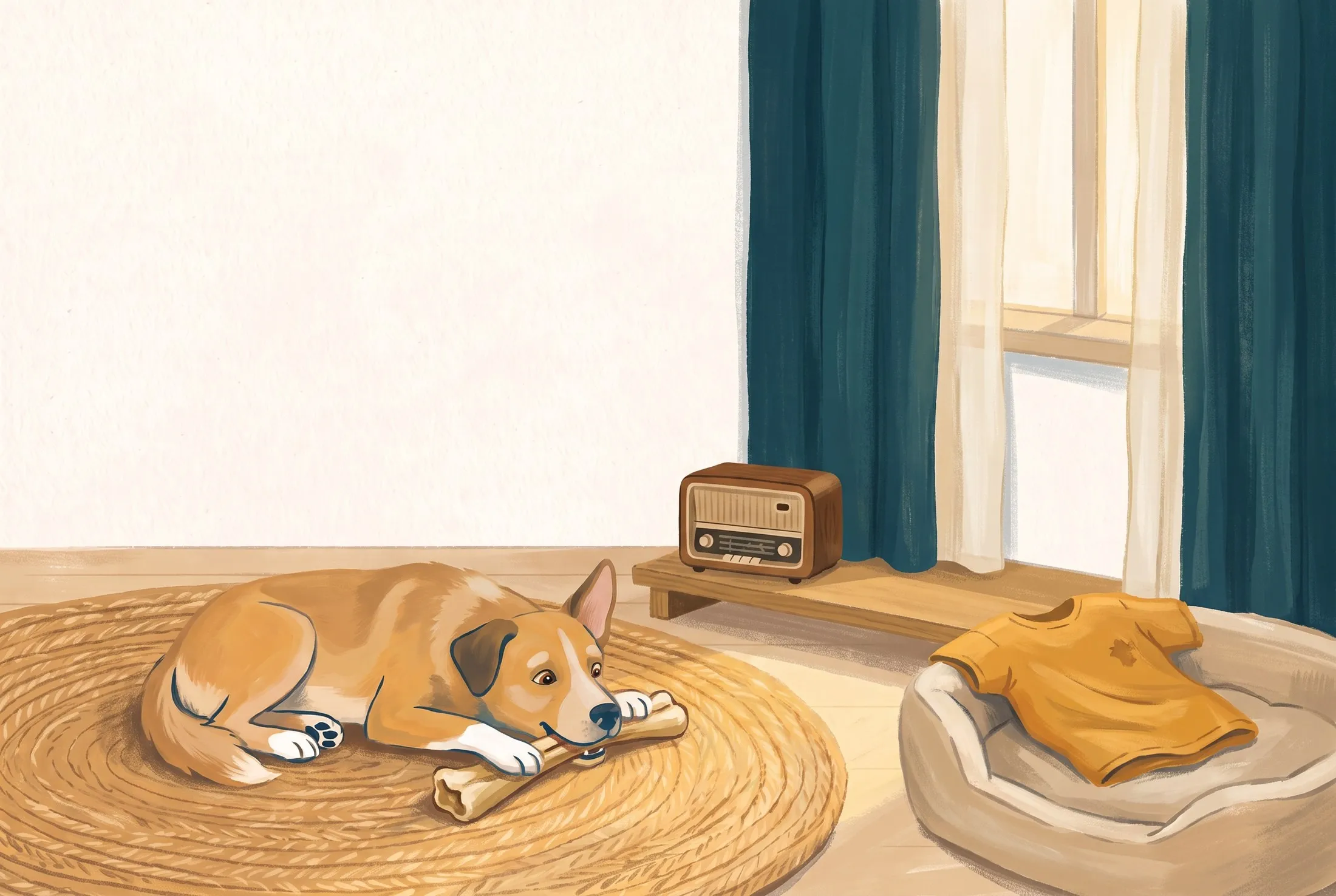
There is a whole industry built around anxious dogs, and when you’re desperate it’s tempting to try everything. Here’s what the evidence actually shows — sorted from “can help” to “doesn’t help”.
One principle first: helpers support the plan; they don’t replace it. In the desensitization study at the heart of separation-anxiety training, the gradual absences did the work (Butler et al., 2011).
Things that can help
A long-lasting chew
Welfare organizations add two important points: this is only likely to help mild cases, because highly anxious dogs usually won’t eat when alone (ASPCA); and if your dog enjoys the chew when you’re home but ignores it when you’re away, that’s a sign they’re worried (RSPCA). A chew is a helper — and a free measuring tool.
Exercise and enrichment while you’re home
Surveys link separation anxiety with less daily exercise (Tiira & Lohi, 2015; de et al., 2025) — correlations, not proof of a cure. Welfare organizations recommend walks, play and food puzzles, and exercise before you leave (ASPCA; RSPCA). Toys alone don’t transform wellbeing: giving dogs toys for 12 days made no significant difference to activity, appetite or mood in one study (Chan et al., 2023).
Sound: radio, white noise, music and dog TV
These studies were in shelters, not homes. The most practical use of sound is to mask outside noises that set your dog off (RSPCA; VCA Animal Hospitals). Ordinary radio or white noise is fine.
Something that smells of you
In a small study of 28 dogs with separation anxiety, their owner’s worn clothing or a recording of their voice reduced the early rise in cortisol (Shin & Shin, 2016). An unwashed T-shirt costs nothing — only if your dog doesn’t chew fabric.
Things with weak or mixed evidence
| Product | What the evidence says | Verdict |
|---|---|---|
| Pheromone diffusers & collars | Most studies gave insufficient evidence they work for problem behaviors (Frank et al., 2010); one better-controlled trial found less crying in newly adopted puppies (Gaultier et al., 2008) | Possibly useful for new puppies; not a treatment on its own |
| Pressure wraps / anxiety vests | A 2024 review found only four studies good enough, and weak, limited evidence (Mathis et al., 2024) | No harm reported, but unlikely to be enough |
| Supplements & CBD | Most alternative products unlikely to be sufficient alone (Riemer, 2023); CBD research is early and mixed (Hunt et al., 2023; Masataka, 2024) | Not a substitute for a plan; check with your vet |
| “Dog music” | No extra benefit over ordinary classical music (Lindig et al., 2020) | Save your money |
Things that don’t help — and can make it worse
- Punishment of any kind is linked to more stress and more behavior problems, including separation problems (Vieira et al., 2020; Dodman et al., 2018). Veterinary behavior experts recommend only reward-based methods (AVSAB 2021).
- Shock, bark and spray collars punish the distress, not the cause (China et al., 2020; Cooper et al., 2014; FVE/WSAVA 2024).
- “Crying it out” in a crate — welfare organizations advise against it (RSPCA; ASPCA).
Common questions
What can I give my dog for anxiety without a vet prescription?
Nothing that replaces a plan. Most 'alternative' calming products — supplements, herbal remedies, pheromones, essential oils — are unlikely to be sufficient on their own. Check with your vet before giving any supplement, especially if your dog takes medication.
Melatonin or CBD for calming dogs — which is better?
Neither has strong evidence for separation anxiety. For CBD, one blinded study found a single dose reduced some, but not all, stress measures in dogs left alone, and a tiny study of 10 dogs found less vocalizing. The research is early and mixed. Ask your vet.
Does dog TV or calming music work?
In shelters, classical music reduced stress signs on the first day, but the effect faded within a week; varying the music helped. A review of nine studies found no extra benefit from music made specially for dogs. At home, the most practical use of sound is masking outside noise.
Stop guessing how long to leave your dog.
An 82-page illustrated guide, a fillable workbook, an Excel tracker that tells you what to do after every session, and a one-page card for the fridge. 111 cited sources.