Dog barking, howling or whining when left alone: what it means and what helps
The sound your dog makes is a clue. Whining, barking and howling when you leave usually signal distress or frustration — and a bark collar punishes the distress, not the cause. Here's what to do instead.
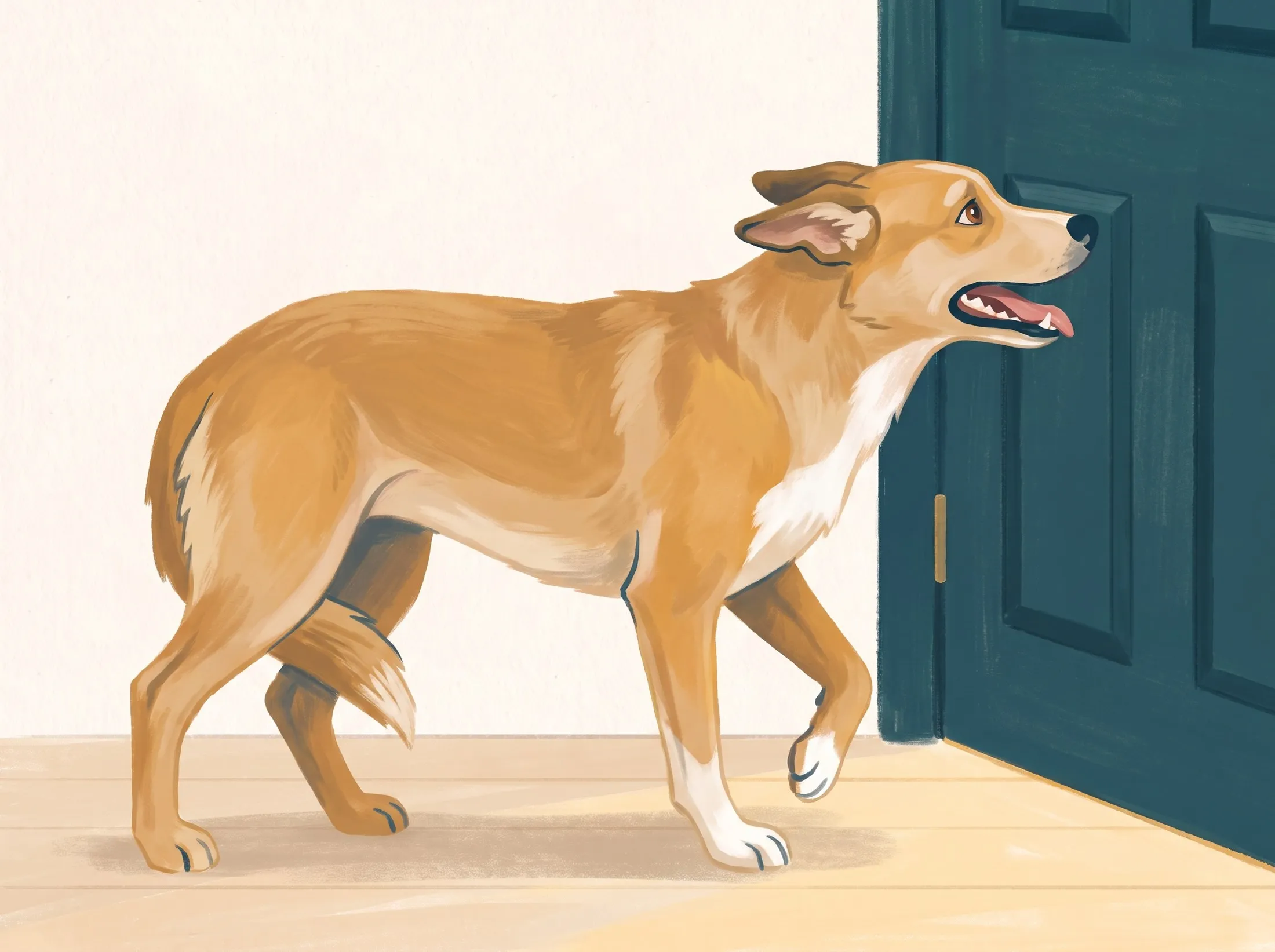
You close the door and within seconds — or minutes — it starts. Whining, barking, a long howl that the neighbors have started mentioning. It’s one of the most common signs of separation problems, and one of the most stressful to live with (ASPCA; RSPCA).
First: does it happen only when your dog is alone?
This is the most useful single question. If the barking also happens when you’re home — at passers-by, at the doorbell, at noises — it may be reactivity to outside triggers rather than separation distress (ASPCA). If it happens only when you’re gone, and starts within a few minutes to half an hour of you leaving, it points strongly towards separation-related behavior (RSPCA).
Free checklistIs it separation anxiety?Signs, the key question, and the look-alikes — in two minutes.Take the checklist →The sound is a clue
Board-certified veterinary behaviorists make the same point: some dogs are more frustrated than anxious, some settle as long as anyone is with them, and some only with one particular person (VCA Animal Hospitals).
Don’t punish the noise
Scolding when you get home doesn’t work either: your dog can’t connect it with the barking that happened earlier, and it makes the next absence more frightening (RSPCA).
What actually helps
- Film it. Find out when the noise starts. That time is your dog’s threshold — the number the whole plan is built on.
- Practice absences shorter than that. Many short, calm absences, lengthened only while your dog stays quiet and relaxed. This systematic desensitization is the method with the best evidence (Butler et al., 2011; Sargisson, 2014).
- Cover the rest of the day. While you train, avoid leaving your dog alone longer than they can cope with — a sitter, friend or daycare your dog enjoys (ASPCA; VCA Animal Hospitals).
- Mask outside noise. If your dog reacts to sounds, ordinary radio or white noise and closed curtains can help (RSPCA; VCA Animal Hospitals).
- Check for noise fear. 63% of dogs with separation anxiety also had noise phobia in one study of 141 dogs (Overall et al., 2001). If your video shows your dog reacting to sounds, tell your vet.
When to get help now
Common questions
How long will a dog with separation anxiety bark?
There's no fixed length — some dogs bark for minutes, others on and off for hours. Film an ordinary absence to find out what really happens, and when it starts. That start time is your dog's threshold.
Will a bark collar stop it?
It shouldn't be used. Controlled studies found no advantage for electronic collars and more signs of stress, and European veterinary bodies and WSAVA say devices that cause pain or discomfort should not be used. It punishes the distress, not its cause.
Why does my dog cry when I leave?
Usually because being alone is frightening or frustrating for them. Research found that dogs prone to fear tended to whine, while frustration was linked to more barking and scratching at the door.
Stop guessing how long to leave your dog.
An 82-page illustrated guide, a fillable workbook, an Excel tracker that tells you what to do after every session, and a one-page card for the fridge. 111 cited sources.