How to teach your dog to stay home alone, calmly
Start far shorter than you think, grow the time only while your dog stays relaxed, and keep practicing even once it works. A practical, evidence-based routine for any dog — anxious or not.
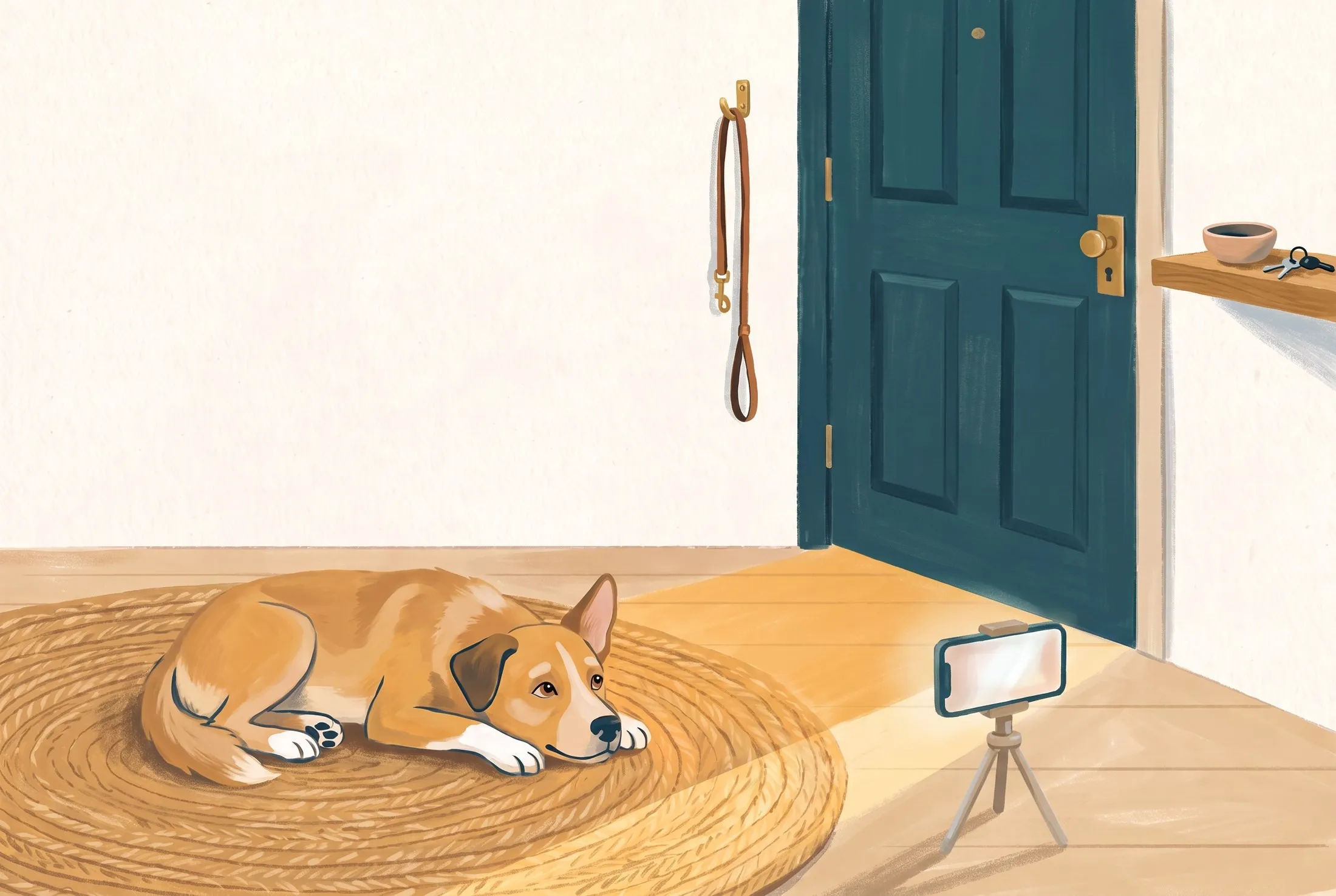
Most dogs can learn to be relaxed at home alone. The secret isn’t a gadget — it’s starting far shorter than you think and letting your dog, not the calendar, set the pace.
If your dog already panics when you leave, the same principles apply but with more care; see our full separation anxiety training plan.
Start with what “calm alone” looks like
That’s your goal: not a dog who “tolerates” absences, but one who uses them to nap.
Step 1: find out where your dog is now
Film one ordinary departure on your phone or a pet camera and watch it back — or better, watch it live. You’re looking for the first sign your dog is no longer settled: ears back, pacing, going back and forth to the door, panting when not hot, whining or barking (Gähwiler et al., 2020; ASPCA).
Free toolThreshold timerTime your dog’s first sign of worry, save each result, and see what your number means.Open the timer →If your dog stays relaxed for 30 minutes or more, you’re in good shape — keep practicing and build up gently. If worry starts within seconds or minutes, treat it as separation anxiety and follow the full plan.
Step 2: practice tiny absences, often
- Start inside the house. Step behind an inside door — a bathroom or bedroom — for a few seconds before you practice at exit doors (ASPCA).
- Keep each absence below the point of worry. The expert rule: practice absences should be shorter than the time it takes your dog to get upset (ASPCA).
- Wait for calm between reps. Leaving again while your dog is still excited from your return makes the next absence harder (ASPCA).
- Vary the length. Mix easy absences with slightly longer ones rather than always going longer (VCA Animal Hospitals).
Step 3: make leaving boring
Dogs learn that keys, shoes and coats predict your disappearance. Take the meaning out of them by doing them many times a day without leaving — shoes on, then sit down with a cup of tea (ASPCA; VCA Animal Hospitals). Keep goodbyes and hellos calm and low-key: don’t ignore your dog, but don’t make a fuss (VCA Animal Hospitals).
Step 4: set your dog up for success
- Exercise and enrichment first. Welfare organizations suggest exercise before you leave so your dog is more likely to rest (ASPCA; RSPCA).
- A long-lasting chew. In a small study, a long-lasting chew produced calmer emotional states than food toys when dogs were left for 20 minutes (Flint et al., 2023). If your dog ignores it when you’re away, that’s a sign they’re worried (RSPCA).
- Mask outside noise. Ordinary radio or white noise can cover street sounds; there’s no extra benefit from special “dog music” (Lindig et al., 2020).
- Block triggers. Close the curtains if passers-by set off barking (RSPCA; VCA Animal Hospitals).
Step 5: keep it going
Even once your dog is relaxed, keep some short, random absences in your week — and if a big schedule change is coming, like a return to the office, start building up several weeks ahead.
Know the limits
Even for a relaxed adult dog, UK welfare organizations advise not routinely leaving them for more than about four hours, and puppies for much less (PDSA; RSPCA).
Free starter guideFind your dog’s numberThe complete threshold-test chapter, the five rules and the Quick-Start Card. Free PDF.Get the free guide →Common questions
What's the best way to leave a dog home alone for the first time?
Keep the first absences tiny — seconds, not minutes — and come back before your dog shows any sign of worry. Watch on a live camera if you can. Build up only while your dog stays relaxed.
Should I leave the TV or radio on?
Ordinary radio or white noise can help mask outside noises that set some dogs off. There's no evidence that special 'dog music' works better than ordinary classical music.
My dog is fine now — do I still need to practice?
Yes, a little. Researchers recommend teaching dogs to cope with being alone even when you don't currently need to leave them, and dogs whose time alone dropped sharply were most at risk when routines changed.
Stop guessing how long to leave your dog.
An 82-page illustrated guide, a fillable workbook, an Excel tracker that tells you what to do after every session, and a one-page card for the fridge. 111 cited sources.